





Truck Sizing: A Guide on Buying Your Next Truck
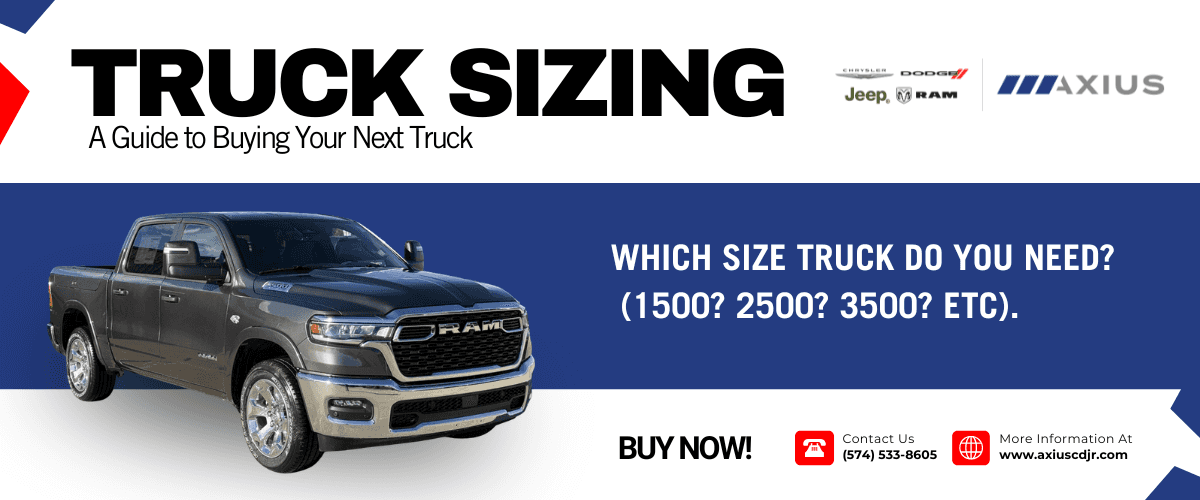
If you’re in the process of buying your next truck, you may be curious about which truck is the right one for you and your needs. You may be looking to tow a trailer, RVs, livestock, or something else. Buying the right truck for the job is paramount, and you want to know exactly what you’re looking for when you start your search.
What does the number in RAM 1500 or RAM 2500 even mean?
The number after the model of a truck (i.e., RAM 1500) refers to the max payload and the truck’s duty class. 1500s are known as “light-duty” trucks; 2500s and above are all known as “heavy-duty” trucks. These designations are in place to make it easier for consumers to understand their needs and know what size truck is the best for them. Most non-industrial needs are perfectly met using a 1500 or a 2500, but there are reasons to use one or the other or to go with an even heavier-duty truck.
Learn the Differences
1500s and 2500s are the most common truck types and are the ones you are most likely to see on a lot on any given day. 1500s, or “half-tons,” are the most commonly bought truck size. They are often noted as driving most similarly to a regular car or SUV and usually come in gas or diesel options. The RAM 1500 can tow up to 11,610 lbs, which is enough for normal day-to-day needs like small trailers and for DIY projects and home uses. These trucks are generally best suited as daily drivers and are also going to be your cheapest option, starting at around $42,025 as of March 2026.
2500s, or “three-quarter tons,” are the next size up and are slightly less common on the road but are still a go-to for farmers, work trucks, and those wanting to tow larger loads. They sport a towing capacity of 20,000 lbs, which makes them a great all-around-use truck. Someone may find use for them at home pulling larger boats and RVs, but they are best suited as a work truck option for pulling small manufactured homes or larger payloads. These have a starting MSRP of $46,855 and also come in gas and diesel options.
3500s, or “one tons,” are next and offer an even greater towing capacity. They don’t do very well as daily drivers and are best suited for towing some serious weight. They are great for fifth-wheel trailers, heavy farm or industrial equipment, or large recreational vehicles. They have a capacity of up to 36,610 lbs while still being able to have a standard bed for even more space to haul. The RAM 3500 starts at $48,155 as of March 2026.
4500s offer a slightly lower max capacity than the 3500s, but because of the chassis cab style they come in, as do the 5500s, they offer a significantly better payload capacity and also excel in handling when the weight approaches its maximum of 29,440 lbs. The 5500 tops out at about 34,540 lbs, and both of these options are best suited for very large loads like 5th wheel trailers, very large RVs, industrial equipment, and more.
Payload vs. Towing Capacity
If you’re not sure what the difference between payload and towing capacity is, worry not! Here is a quick breakdown.
- Payload refers to the maximum amount the truck itself is able to carry, which includes its body weight, passengers, and any items in the bed.
- Towing capacity refers to the amount the truck can pull behind it, like trailers or boats.
These numbers are different but are both important when picking out your next truck.
How to choose which size is the best for you
The most important thing is to know what your purpose is. Are you looking for a daily driver or only need to tow smaller trailers or boats? Or are you needing a larger towing capacity? Also it is important to know if you want gas or diesel. Once you get into the heavy-duty sizes, many people prefer diesel, but there are still gas options. If you go to the dealership with an idea of your goals in mind, they will help steer you in the right direction from there.
Summary
Overall, choosing the right truck for you is simple: how much weight do you need on the truck itself, and how much weight do you need to be able to tow? For most everyday use a 1500 or 2500 will be plenty, but if you’re in need of a serious workhorse, there are options available to you.
Shop Our RAM Trucks Here: RAM Trucks
FAQ:
Q: Is this the same across all brands?
A: All brands use the same numbers (1500s, 2500s, 3500s, etc.), but the towing and payload capacities will vary a little between brands.
Q: Is it better to go up 1 size from what I actually aim to do with my truck?
A: Unless you see your needs changing, you should generally go with the smallest truck that fits your needs. Getting a 2500 when you only need a 1500 will cost you more in fuel, be more expensive to buy, and be worse to handle on the road.
Q: Does the engine option change capacity?
A: Yes! At each level the engine size and type (gas or diesel) do make a noticeable difference in the towing capacity. It is best to look at the specific model you want to see what its actual max towing capacity is.
0 comment(s) so far on Truck Sizing: A Guide on Buying Your Next Truck